Category: Uncategorized

  • National Asbestos Awareness Week 2025

    National Asbestos Awareness Week 2025

    asbestos awareness week 2025

    This week marks National Asbestos Awareness Week, 24-30 November, a vital reminder that the risks from asbestos haven’t disappeared.

    Despite the ban, ageing and deteriorating asbestos-containing materials remain in homes and workplaces across Australia. While many believe this is a problem of the past, the reality is different. Every year, an estimated 4,000 Australians die from asbestos-related diseases.

    It’s estimated that one in three homes still contains asbestos materials, hidden in walls, roofs, flooring and sheds.

    This week isn’t only about raising awareness, it’s a time to honour those living with, and lost to, asbestos-related illnesses and to act to keep others safe.

    What you can do:

    • If you’re planning work on a home built or renovated before 1990, pause and ask: could it contain asbestos?
    • Don’t assume materials are safe simply because they look intact; damage or disturbance can release harmful fibres.
    • If in doubt, engage a licensed asbestos assessor or removal professional.
    • Share this message with tradespeople, DIY-renovators and anyone who might unknowingly come into contact with asbestos.

    Awareness is the first step in preventing future asbestos-related diseases. This week is an opportunity for all Australians to learn how to identify risks, seek expert guidance and make safer choices at home and at work.

  • Smart tradies always check for asbestos before starting work

    Smart tradies always check for asbestos before starting work

    Smart tradies know the risks. Disturbing asbestos-containing materials can release dangerous fibres into the air. Always check before you start, especially in buildings built before 1990.

    Smart tradies check for asbestos
  • Renovations can disturb Asbestos: know the risks before you start

    Renovations can disturb Asbestos: know the risks before you start

    Renovations can disturb asbestos-containing materials, releasing microscopic fibres into the air. Inhaling these fibres poses serious health risks, including diseases such as asbestosis, lung cancer, and mesothelioma.

    Asbestos was commonly used in Australian homes built before 1990, found in materials like cement sheeting, insulation, and floor tiles. Disturbing these materials during renovations can make asbestos dangerous. It’s crucial to identify and manage asbestos properly to ensure safety during renovation projects.

    Renovations can disturb asbestos
  • Is asbestos in your home?

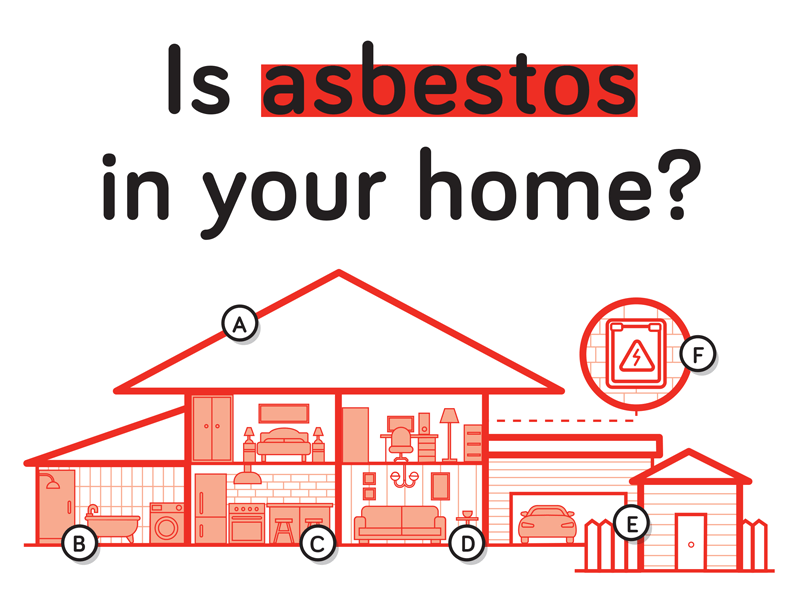
    Is asbestos in your home?

    Homes built before 1990 may have asbestos in the following areas:

    Exterior

    Roof sheeting, gutters, downpipes, ridge capping, imitation brick cladding and lining under eaves.

    Bathroom, toilet and laundry

    Wall and ceiling panels, vinyl floor tiles and backing for wall tiles.

    Kitchen

    Wall and ceiling panels, backing for splashbacks, vinyl floor tiles, backing of vinyl flooring and insulation in stoves.

    Living areas

    Wall and ceiling panels, carpet underlay and insulation in domestic heaters.

    Backyard

    Fences, garden sheds, garages, carports, outdoor toilets, dog kennels, buried and dumped waste materials.

    Other areas

    Backing of electrical switchboards, insulation in roof cavities, hot water pipe insulation, textured paint and plaster patching compounds.

    Find out more at asbestossafety.gov.au

    Is asbestos in your home?
  • Working on a pre-1990 build?

    Working on a pre-1990 build?

    Your house could contain asbestos.

    Beware of asbestos. Asbestos can kill. Visit asbestossafety.gov.au

    Working on a pre-1990 build
  • Maree Stokes receives NSW Community Service Award for 2024

    Maree Stokes receives NSW Community Service Award for 2024

    Maree Stokes receives NSW Community Service Award for 2024

    We are proud to share that Maree Stokes of the Asbestos Diseases Foundation of Australia (ADFA) has been honoured with a Community Service Award for 2024 from the NSW State Government. This well-deserved recognition was presented by Liesl Tesch, MP for Gosford.

    In presenting the award, Liesl Tesch said:

    “With great honour, I would like to recognise Maree Stokes for her commitment to supporting and advocating for people who are living with asbestos related diseases as well as their family members, carers, and friends. Maree has been the Coordinator of the Central Coast Support Group for the Asbestos Diseases Foundation of Australia ADFA for almost two decades. This Group meets monthly and offers support, help and friendship to those suffering with asbestos related diseases. On top of that, Maree is always willing to speak with those who are looking for support about their recent diagnosis and continues to check up on them to see how they are travelling along. Maree’s tireless efforts are much appreciated by ADFA and those she assists. Maree’s dedication, passion and hard work raising awareness has been a great pride and inspiration for her friends and family. I applaud Maree for her marvellous contributions to our Central Coast community and beyond.”

    For nearly 20 years, Maree has provided support, guidance, and friendship to individuals and families affected by asbestos-related diseases. Her dedication to advocacy and community support is truly inspiring, and this award is a testament to the incredible impact she has made.

    On behalf of ADFA, we extend our heartfelt congratulations to Maree on this well-earned recognition.

    Maree Stokes receives NSW Community Service Award for 2024 from MP Liesl Tesch

    Maree Stokes receives NSW Community Service Award for 2024 from Liesl Tesch, MP for Gosford

  • Correspondance from David Mehan MP regarding Dust Diseases Bill

    Second Reading Debate on Worker’s Compensation (Dust Diseases) Amendment Bill.

    Please see below latest correspondence from David Mehan MP – Member for the Entrance.

    https://adfa.org.au/wp-content/uploads/2022/10/DOC071022.pdf